Bosbury Bells, 1898, 1903, 1937
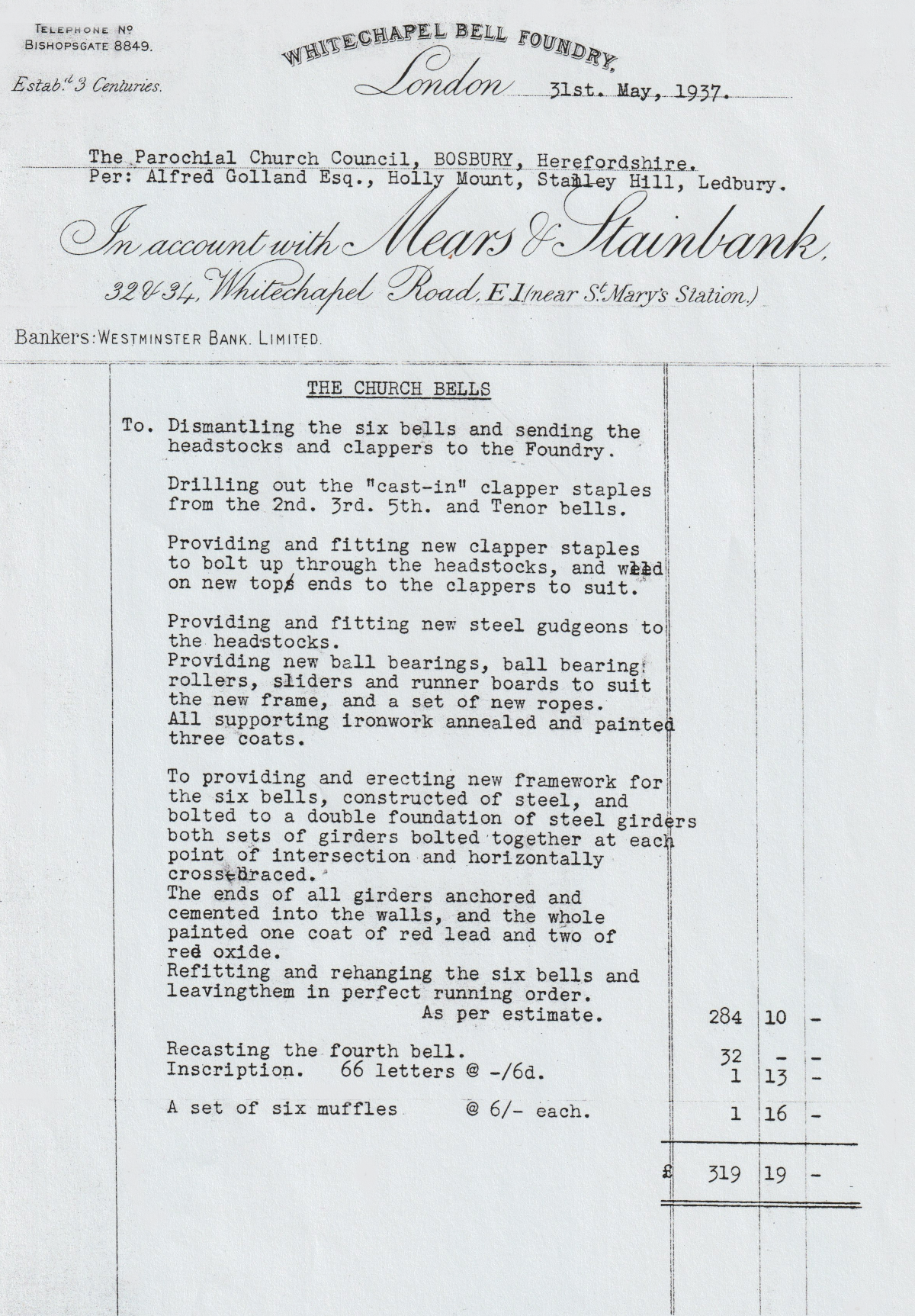
This is a report, specification and estimate from W. Greenleaf of Greenleaf & Tristram of Hereford on the state of the Bosbury bells and his invoice for the work done. Also an invoice from Whitechapel Bell Foundry 34 years later.
Date July 28th '98
Bosbury Parish Church Bells.To the Vicar and Church Wardens of Bosbury Parish Church
Revnd. Sir & Gentlemen,
I thank you for the invitation top inspect the Peal of six Bells in the Tower of your Church. I now forward my report upon their present condition, also an estimate for their restoration.
Report
I find the Bells are to all appearances sound but I cannot say I consider them a good Peal. The Treble is (I think) the worst Bell, it is very dead & lacking in vibration & if funds permit it, I would advise that it should be recast. A better Treble would much improve the Peal. The Clappers of all the Bells are in a very bad state & are quite unsuited to the Bells. All the Bells are (except the Treble) very deeply indented at the sound Bows where the rude, rough Clappers have struck them for so many years & the Peal is very much out of Tune, the 3rd. being sharp & the 4th. flat and the other Bells are out of Tune but to a lesser degree. I am certain that if the bells are properly Tuned, quarter turned & fitted with new Clappers that will strike them upon the proper parts of the sound Bows, the Peal would be immensely improved.
The Frame
The Frame and the Beams which support it are very old & has been much cut about but, being originally constructed with very heavy timber, the cutting has not greatly reduced its strength but time has made it somewhat rickety at the joints & I notice there is rather bad place on the side of the Tenor pit at the bottom part which will need special attention. I took particular attention of the Beams which support the Frame, certainly some of them, are somewhat decayed but the main Beams are substantial and fairly sound. It is those that run transversely across the main Beams that are in some cases faulty but you will notice that the Transverse Beams are very numerous in fact four or five of them being almost side by side & as most of them are fairly good I believe the Frame & Beams will do good service for many years to come if proper attention is given to them now, I would advise that the Frame should be carefully repaired where needed & the loose joints properly wedged up & strong angle plates fitted to all the joints & corners of the top part of the Frame.
The whole of the Fittings are completely worn out. No part of them can be used again with advantage. If the Cannons are carefully removed from the four largest Bells & the Peal rehung with modern Fittings so that there would be more of a counter balance, the strain upon the Frame and Tower would be much reduced.
Assuring you that you may rely upon my best attention being given to the work if entrusted to one I am
Yours respectfully
W. Greenleaf
P.S. The diam. of the Tenor Bell is 3ft. 10 in. & and 2⅞ thick at the sound Bow & the close approximate weight is 16 cwt. the treble Bell would weigh approximately 6½ cwt.
Specification & Estimate
To take out the Peal of six Bells. To rehang the Peal of six Bells with all new Fittings complete, consisting of Wheels with seasoned Oak Frames & Elm Rims. Best seasoned Elm Stocks fitted with Gudgeons let into substantial cast Iron bed plates upon the newest principle & all necessary wrought Ironwork for attaching the Stocks to the Bells. New black Gun Metal Bearings dove-tailed in strong cast Iron carriages with improved hinged Caps for conveniently oiling the Gudgeons. All new Rollers, Stays, Sliders, Slider Runners & wrought Iron Wheel Braces &l; new best wrought Iron Clappers.
To fit reverse Staples to the five largest Bells so that the Clappers may strike them at right angles of the present indents, & Tune the Peal of Six Bells & leave the Peal of Six Bells complete and ready for use, to the satisfaction of any practical person or persons you may desire to inspect the work when completed for the sum of Fifty seven pounds, Ten shillings. £57.10.0
To carefully repair the Frame, when necessary wedge up all loose joints & fit & bolt strong cast iron Angle plates to all the joints & corners of the Frame, eight Pounds fifteen Shillings £8.15.0 (Total) £66.5.0
The estimate includes mens time, use of Tackle, Carriage journeys & all Changes except the carting of all Tools, Tackle and Materials to & from the nearest railway station.
To remove the Treble Bell for Recasting. To recast the treble Bell aproximately 6½ cwt. at £1.15.0 per cwt. including carriage of the old and new Bells to and from the founders & hoisting the new Bell , for the sum of Fifteen Pounds, seven Shillings & six Pence £15.7.6
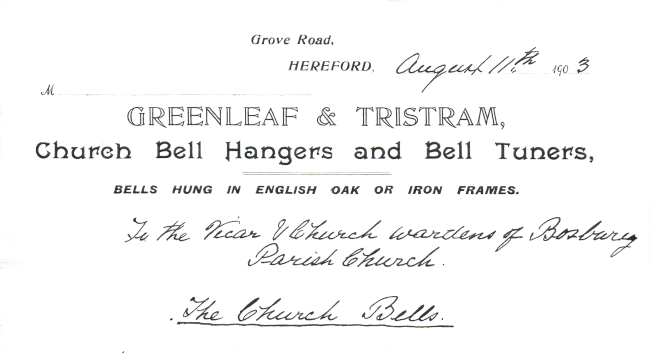
The Church Bells
To removing the peal of six Bells from their old Bearings and rehanging the peal of six Bells, with all new fittings complete & quarter turning the Bells so that the clappers may strike them upon the undented part of the sound Bows & Tuning the Bells as per specification and Estimate Fifty Seven Pounds Ten Shillings £57.10.0
To repairing the old Frame & fitting Strong Iron Angle plates to Joints where necessary as per Specification and Estimate Eight Pounds Fifteen Shillings £8.15.0
To taking down the Treble Bell for recasting & hanging the recast Bell including carriage and all charges as per Estimate £15.7.6
Extras. To refixing Clock Hammer ".15."
To altering the circle of the Ropes including boring through Floors. 1.6."
£83.13.6
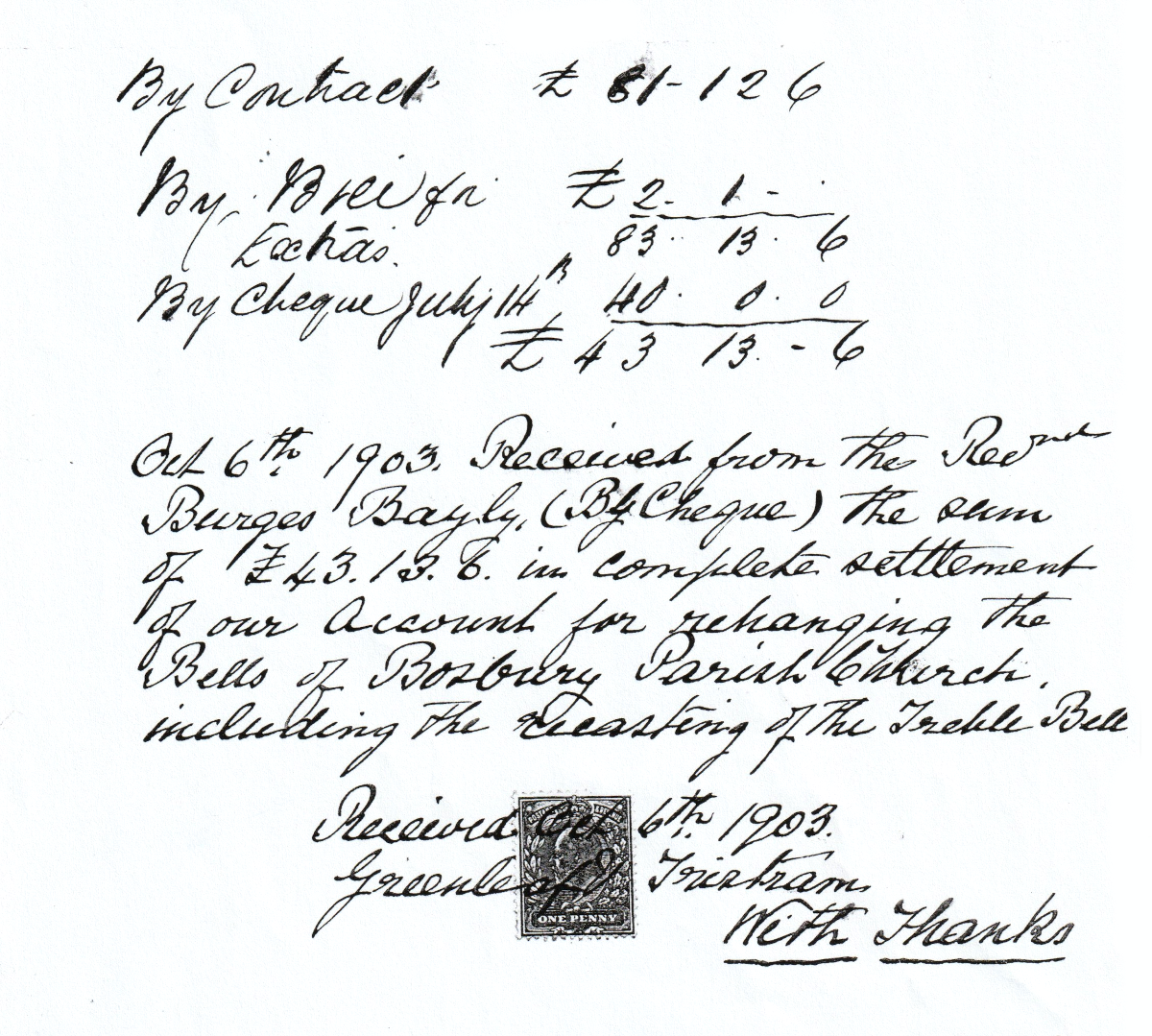
The new treble bell was cast by James Barwell & Co. at their Great Hampton Street foundry, Birmingham. Greenleaf & Tristram received a cheque for £40 on account on July 14th 1903 and the balance was paid on October 6th 1903.
Transcription: B.S.Sharples 2026.

